
The Long Watch
A Novel of the Hesper Relay
Hesper Relay Chain · Dray Lane · Hollis Dray Charter, hull 217
Standing Order 12: A maintenance vessel on station shall hold station until properly relieved. Relief shall be dispatched at the close of the standard tour. There is no provision for a vessel to withdraw on its own initiative. — Hollis Dray Charter, Contract Office, Cradle
This is the log of the repair tender Tallow, hull 217, held on station at Hesper Nine, in the hollow of a dead star, for eight hundred and twelve days. It is transcribed from the ship's recorder, from the relay's recovered packet buffer, and from the private journals of her crew. It has been lightly edited for clarity. Nothing has been removed.
Chapter 1: Holding Station
Ora Devane woke at ship's morning, which came five times a day because the drum turned and the lights obeyed the drum, and lay still for a moment with the flat of her hand against the bulkhead, feeling the hull turn under it.
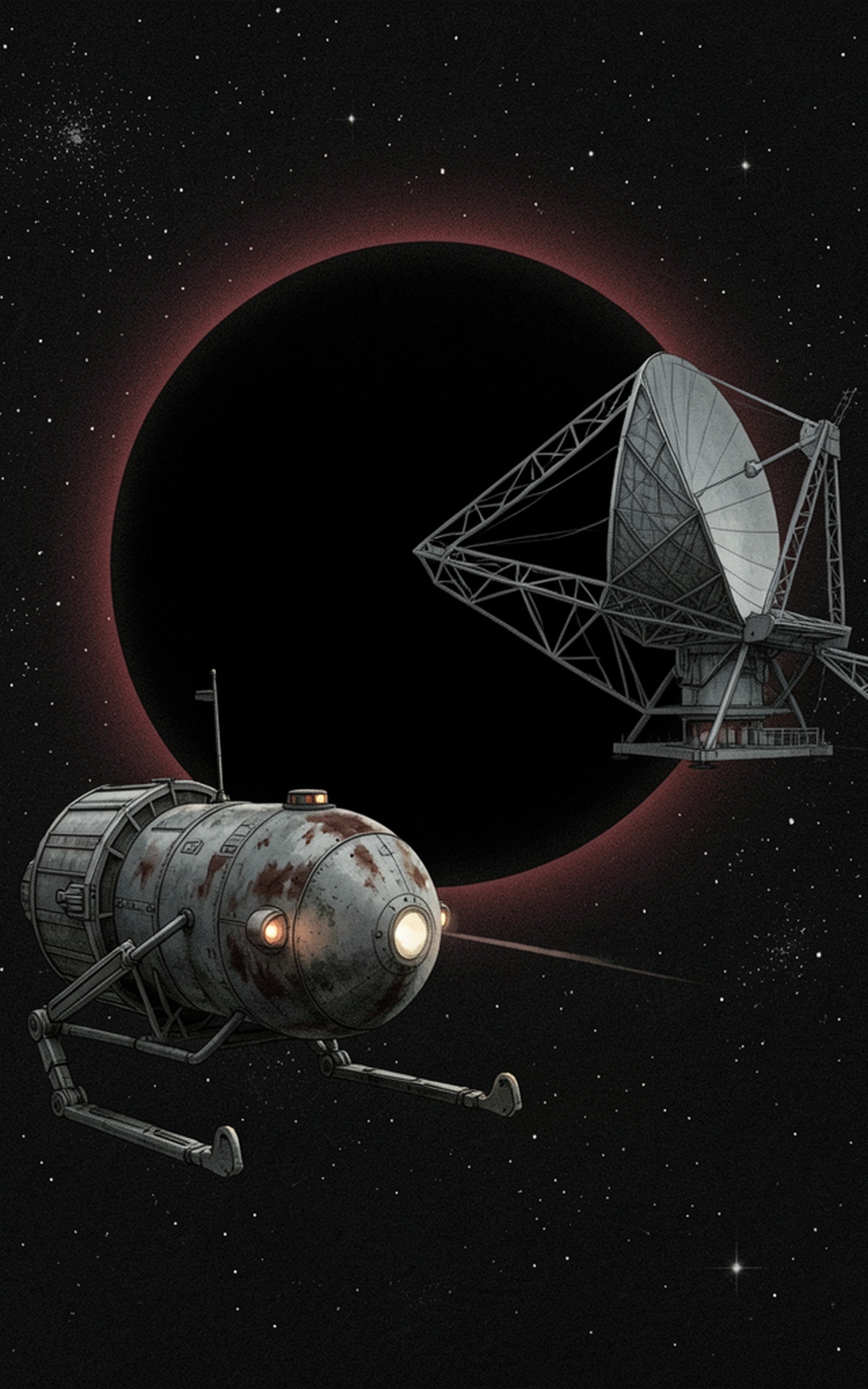
The Tallow was ninety-one metres from nose to tail: a spine, a drum, a machine shop, two grapple arms folded against the flank like the legs of something dead, and a reactor that had opinions. Hollis Dray Charter had built six of the class and lost two. The Tallow was hull 217, forty-one years in service, and for eight hundred and twelve days of that service she had not moved.
Ora sat up. Her knees complained about it. She was fifty-eight, which was not old anywhere except aboard a hull designed for people of thirty.
She dressed in the dark—grey-blue coverall, ship patch on the shoulder, the fabric worn to suede at the elbows—and went forward to the blister. The blister was a bubble of glass substitute set into the ship's nose, and it was the only room on the Tallow that had no function. Ora had never once heard anyone complain about the waste of it.
Hesper hung below her.
It was a dead star. Not dying—dead, finished, out. A black dwarf: the last state of a small sun that had burned everything it had and then cooled for a hundred billion years until there was nothing left in it but cold degenerate matter and the faint dull red of a thing that had almost forgotten how to be warm. It gave no light you could read by. It made a sphere of absolute black against the field of stars, and around its rim there was a thin red smear, like the last line of a fire seen through a window at three in the morning.
You could cover it with your hand. Ora had done that, once, in her first week, and then never again.
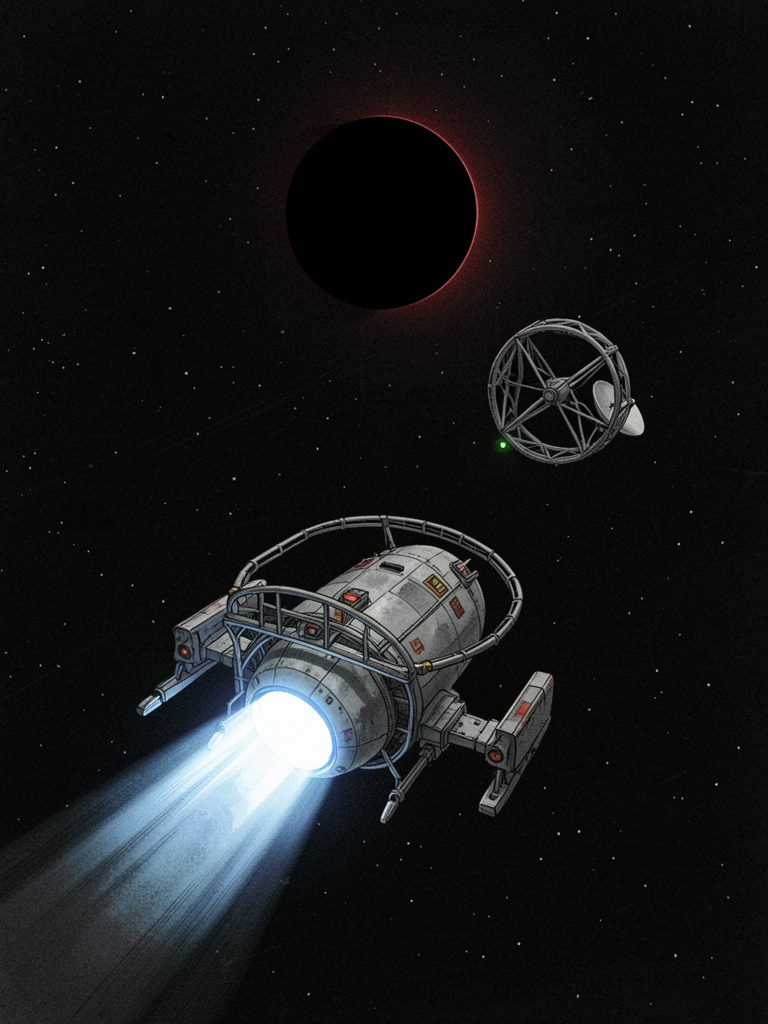
Hesper Nine hung between the ship and the star: four hundred metres of truss and dish and antenna, an old relay station built in the fat years when the Dray lane ran through this hollow and every automated hauler in the chain steered by it. Sixty-one years old, at least. Its skeleton turned slowly, once every eleven minutes, keeping its great dish pointed down the lane. From the blister it looked like a wheel of black wire with one eye open.
Ora put her hand on the cold glass and said, quietly, to nobody, “Good morning.” Then she went to work.
The log took four minutes. She had been giving it four minutes for eight hundred and twelve days and she could feel the shape of the words in her mouth before she said them.
“Ship's log. Tallow, Hollis Dray Charter, hull two one seven. Commander Ora Devane. Day eight hundred and twelve.”
The recorder waited.
“Position held. Hesper Nine relay at one thousand kilometres lateral, station-keeping nominal. Relay functions: primary dish tracking; housekeeping bus nominal; uplink amplifier degraded by nine percent since last survey, within tolerance. Ship's systems: reactor at sixty-two percent rated output; feed injector flagged for inspection. Stores: thirty-one percent of rated. Water recovery at ninety-four percent. Crew: five. All living.”
She paused. The recorder waited, as it always did, for the line that had been the same for four hundred and twelve days.
“Relief vessel Amaranth: not arrived. No reply to standing queries. Four hundred and twelfth consecutive query filed.”
She stopped the log.
Outside, the stars did not move, because the Tallow was not moving, and because in this hollow of the dark there was nothing close enough to move against. The nearest lane marker was a hundred and forty million kilometres away. The nearest human being was further than that, and Ora had begun, in the last year, to think about how far that actually was, and to stop herself thinking about it, and to think about it again.
Late shift, the galley
The tally was on the bulkhead above the water tap, where you could not avoid it. A printed card, standard issue, still crisp because it had been printed on board and never handled:
HOLLIS DRAY CHARTER. STANDARD TOUR OF STATION — 400 DAYS.
Below it, Ora had drawn one grease-pencil line for every day past the four hundredth. It had taken her a while to settle on the form. One line per day was too big; the wall would have run out. So she had settled on a grid: ten lines, then a diagonal slash through them, the way you counted in a schoolyard. There were forty-one slashes on the wall, and two lines past the last slash.
Under the last slash, in Teo Marchetti's square engineer's hand: Then why are we still here? Under that, in Hana Reyes's slanting scrawl: Because the coffee's so good. Under that, in Sunna Oyelaran's careful capitals: Day 812.
Ora uncapped the pencil and drew the third line of the forty-second group.
The coffee, as it happened, was not good. It was a brown suspension that the galley produced from a brick of pressed carbohydrate and a mineral supplement, and it tasted the way a hot battery smells. Ora drank it anyway, standing, because sitting down to it felt like admitting something.
Teo came in with his hair wet and his beard dripping. He was sixty-three, heavy through the shoulders, bald on top, and he wore an orange work harness over his coverall even at breakfast, the way other men wear a wedding ring.
“Strut three,” he said.
“What about it?”
“I've been watching it on the hull cams. There's a mark. Might be nothing.” He poured himself coffee and drank half of it in one motion, which was a thing Ora had watched him do for two years and had never gotten used to. “Might be a bend.”
“Debris?”
“This hollow's had sixty years of junk drifting through it and nothing to sweep it out. Something the size of a fist would do it.” He wiped his mouth. “I'd like to go and look.”
Ora looked at the tally. Then she looked at the clock.
“Take the Nail,” she said. “I'll fly the outside.”
Third shift, outside
They went out at third shift, and the work took five hours, and it was, Ora thought later, one of the better days.
The Nail was the Tallow's tender: a box with a motor and four thrusters and a cage of lights, and no concessions at all to the comfort of the two people in suits who sat in it. Hana flew it. Ora and Teo rode in the cage behind, tethered in, watching Hesper Nine come up out of the dark.
You did not see the relay so much as watch it become real. First nothing but a scatter of stars, then a place where the stars did not show, then the trusses resolving out of the shadow in long grey lines, and finally the dish, forty metres across, its surface the colour of old pewter, turning with the whole station once every eleven minutes in a silence so complete that Ora could hear her own breathing inside the helmet, and the blood in her ears.
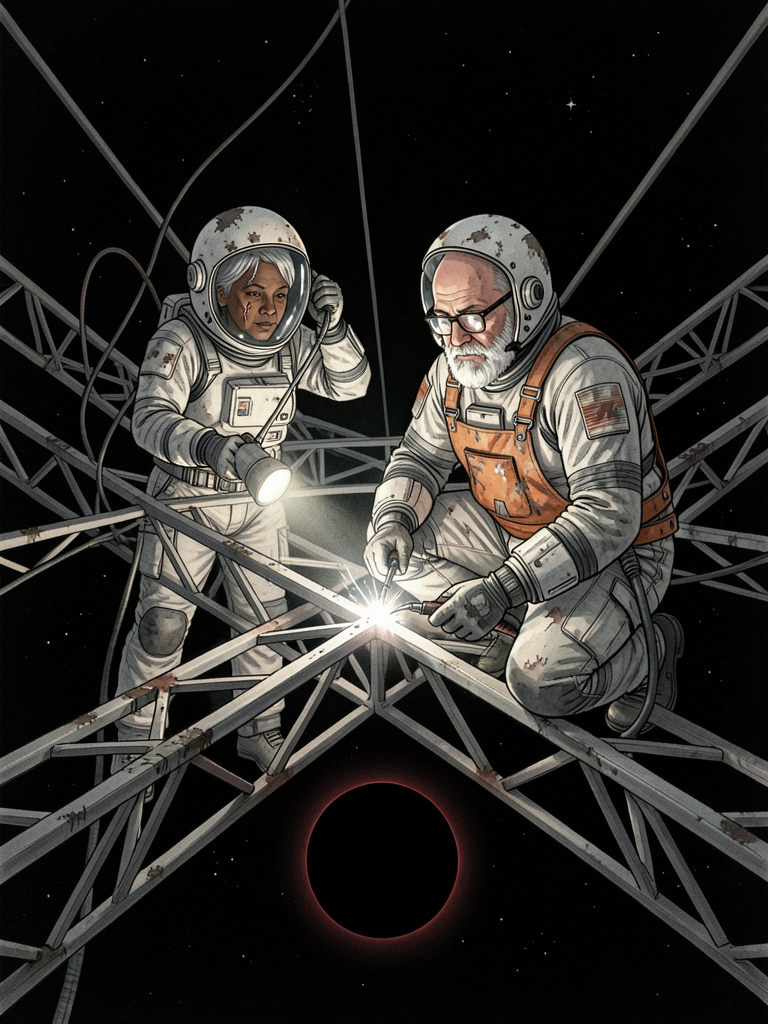
Hana put them alongside Strut 3 and held station with a delicacy that never stopped being worth watching.
“Two metres,” she said. “You're on your own, boss.”
“Always am,” said Ora, and went out.
Outside, in the dark, with the suit's lamp cutting a cone of white through the dust and nothing else, she felt the pull of Hesper the way you feel a height. Forty thousand kilometres below her boots there was a thing that had once been a star, and most of its mass was still there, patient and enormous, and the Tallow had spent two years and change going around it at a distance carefully calculated by an insurance underwriter.
She did not look down. She had learned that in her first year, the way you learn not to look at the sun.
Teo was already at the brace, his harness clipped to the truss, one boot hooked, running his gloved hand along the strut.
“There,” he said. “See it? Right at the weld.”
Ora brought her lamp around. There was a dent the size of a fist, and from the dent a hairline that ran four centimetres along the weld bead and stopped.
“That's a crack,” she said.
“That's the start of a crack. It's not through.” Teo was already unclipping the torch from his belt, moving with the unhurried competence of a man who had done this for forty years and expected to do it for twenty more. “Give me the plate from the cage. The little one, the offcut.”
They worked. Ora held the lamp and passed tools and watched the man work, and time did what time did out there, which is that it went away. The torch made no sound—you felt it in your wrist, in the bones of the hand, a buzzing that got into your teeth. The bead went down, a bright line in the dark that cooled from yellow to red to grey. Twice Teo stopped and made her check the truss alignment against the laser. Twice she made him drink from the tube in his helmet.
Halfway through, her tether caught on a bolt and she pushed off to free it and misjudged the push, and for two long seconds she was drifting with nothing under her except Hesper, black and enormous, and her heart did something ugly.
“Ora.”
“I'm fine.”
“You're fine,” Teo agreed. He had not stopped welding. He had simply put one hand out, palm open, and waited, and when she came back along the line she took it, and he closed his glove around her wrist and put her back on the truss as if she were a piece of stock that needed re-seating.
They finished at hour four and forty minutes. Teo inspected the weld with a magnifier, grunted, and packed the torch away.
“Good as new,” he said.
“It was never new.”
“Better, then. It's been out here sixty years and it's still holding. That's the whole religion, Ora. A thing that's fixed stays fixed.”
Inside, they stripped the suits, and Ilya Voss met them in the lock with a handheld scanner and the expression of a person who had been waiting a long time and intended to make it known.
“Hands,” Ilya said. Ilya was in their forties, ash-blond, hair tied back, with a nose that had been broken twice and set badly once. They took Teo's gloves off him and turned his hands over and made a small, unimpressed noise. “You've got a blister the size of a coin on the heel of your palm and you didn't say anything for two hours.”
“It's a blister.”
“It's a blister in a vacuum, which is a different animal.” Ilya sprayed it and wrapped it. “You're on light duty tomorrow.”
“I'm always on light duty. I'm an old man.”
Sunna Oyelaran came up the spine from the comm bay, hand over hand on the rails, and stopped at the lock with her braid swinging. She was twenty-six, the youngest aboard by a decade, tall and narrow through the shoulders, and she wore the pale green flight suit like a uniform she was still trying to grow into.
“Day eight hundred and twelve,” she said.
“It was,” said Ora. “It's evening now.”
“Right.” Sunna looked past her, at the relay turning out there in the dark. “Anything on the approach band?”
This was the question Sunna asked every day of her watch, and Ora had heard it in every possible tone: eager, in the beginning; then businesslike; then careful, the way you ask about a sick relative; and now, in the last months, in a flat, level voice that wanted nothing, which was the worst of the four.
“Nothing,” said Ora.
“Nothing,” Sunna agreed. “I'll be on watch.”
That night—ship's night, which was also a lie the drum told—Ora sat in her cabin with the query queue open on the screen.
Four hundred and twelve of them. One a day since day four hundred. They were all the same, give or take: Tallow to Hollis Dray Charter, Contract Office, Cradle. Position held. Stores at thirty-one percent. Standing order requires relief at day four hundred. Relief has not arrived. Request instruction.
She had begun the letters formal and ended them formal. Somewhere around the two hundredth she had added a line: A reply of any kind would be appreciated. She had left it in. She had looked at it many times and left it in.
She did not write one tonight. She opened the blister's display instead and looked at the star, black on black, with its thin red rim, and thought about how, in the old charts, before anyone had known what it was, Hesper had been called a waypoint and nothing more—a marker on a lane, a bend in the road, a place you passed.
Ora had been passing through places for forty years. This was the first one that had ever refused to be passed.
She slept.
Chapter 2: The Count
Dinner on the Tallow was at nineteen hundred, and it was the only ceremony the ship had left.
The five of them ate in the galley, which was a room the size of a large cupboard with a table bolted to the floor and five seats bolted to the table, and the rule—Ora had made it in the first month and enforced it with the tirelessness of a woman who had once been a tug pilot and knew what happened to crews that stopped eating together—was that no one ate alone.
Tonight was ration pack C: a flat pouch of something with lentils in it, a flat pouch of something with apricots in it, water, the coffee, and a piece of flatbread that Hana had made on the galley's one concession to civilization, a hot plate.
“I've been running the numbers,” Hana said, to her lentils.
Hana Reyes was thirty-four, broad-shouldered, with black hair pulled into a knot so tight it looked painful, and sleeves rolled to the elbow at all hours regardless of the drum's temperature. She was the Tallow's pilot and quartermaster both, which meant she was the person aboard who knew exactly what they had and exactly what it would buy, and the last year had made her the least popular person at the table.
“You're always running the numbers,” said Teo.
“Because they keep changing.” She put her fork down. “There are two numbers, and everyone in this room knows them. Number one: our stores are rated to day nine hundred. That's eighty-eight days. After that we are eating the hydroponics, and there are no hydroponics, because they died in the second month, and after that we are eating each other, and I have looked at all of you and I want to say now, for the record, that I would start with Teo, because he's the biggest.”
“I'd be honored,” said Teo.
“Number two.” Hana looked up, and her face changed—the joke went out of it, which was worse than if she had never made it. “The burn. To get to the lane marker at Hesper Shoal and put ourselves where traffic might see us, we need ninety percent output for nineteen hours, and then a shutdown, and then a coast of two hundred and twenty days. We have one burn in us. One. That's if we go at full stores.”
“And the reactor cannot give ninety percent,” said Teo, “because the moderator sleeve on the number two injector is cracked, and at ninety percent the feed will flash, and then we will be a very fast cloud of very small pieces.”
“I know that,” Hana said. “I'm the one who asked you.”
“Then stop asking me the same question.”
“Teo,” said Ilya, mildly.
Ora ate. She had learned, over two years, that her silences were the most useful thing she had, and that they cost her something every time she spent one.
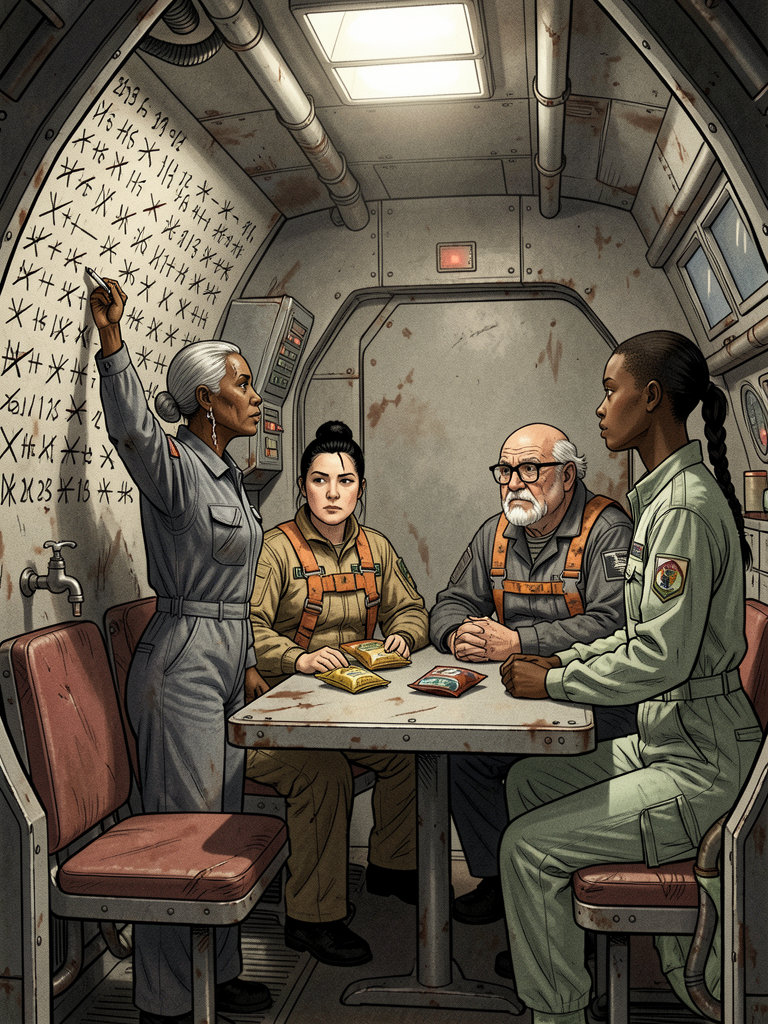
Sunna was not eating. She had her fork in her hand and she was looking at the bulkhead over the water tap—at the card, the grid, the forty-two groups of lines.
“Eighty-eight days,” she said.
“Eighty-eight,” said Hana.
“And they're four hundred and twelve days late. The relief.”
“Four hundred and twelve.”
“I know what the number is.” Sunna put the fork down. “I mean—if they were coming at all, they'd be here. If they'd launched on day four hundred and flown the same track we flew, they'd have arrived on day six hundred and forty. That's a hundred and seventy-two days ago. That's—that's almost half a year ago, Hana. I've been sitting in the comm bay for a hundred and seventy-two days listening for a ship that should have arrived half a year ago, and there is nothing on that band. Not a carrier, not a whistle, nothing. Not even noise where noise shouldn't be.”
The galley was quiet. The drum turned, one silent revolution every fifty-seven seconds, and nobody said anything for one of those revolutions.
“Say what you're saying,” said Ora.
“I'm saying they're not coming.”
“And?”
“And we should talk about what we do about it,” Sunna said, and her voice cracked on the last word, and she picked her fork back up and ate a bite of lentils as if she could put the whole sentence back in her mouth with them.
Ilya wiped their hands on a cloth.
“For the record,” Ilya said, “and I will be putting this in the medical log whether anyone likes it or not, morale is no longer satisfactory.” They looked around the table with the flat gaze of a person who had been keeping five people alive from the inside for two years. “I have been writing satisfactory in that log for eleven months. I want everyone here to understand that I did it because the contract says a vessel whose crew is rated unfit is a vessel whose crew is not paid, and I wanted you all to be paid, and because I was afraid of what it would mean for us to be officially unfit. That's the truth. I'm done lying to a form. We're not satisfactory. We're a crew of five people sitting in the dark being angry with each other.”
“I'm not angry,” said Teo.
“You are.”
“I'm disappointed,” said Teo. “It's different. I'm disappointed in the company. I'm not disappointed in the relay.”
“The relay is a wheel of wire,” said Hana.
“The relay is our post.” Teo set his fork down, and when he spoke again his voice had gone quiet, which it only did when he was genuinely angry, and the others at the table recognized it and let him finish. “We were sent here to hold station and keep that relay alive, and for eight hundred and twelve days that is exactly what we have done. You can call that meaningless. It isn't meaningless. Do you know what happens on the Dray lane if nobody keeps the chain? The automated haulers steer by the chain. They have no eyes. They have a receiver and a set of instructions and a course, and if the chain goes dark they don't stop—they keep going, blind, at a quarter of a percent of c, until they hit something. That is the entire reason the chain exists. It isn't a light for us. It's a fence.”
“There hasn't been a hauler through this hollow in nineteen years,” said Hana. “The lane moved. The company moved it and built a new chain two hundred million kilometres spinward and left this one running because it was cheaper to leave it running than to come out here and switch it off. There is nothing to steer. There is nothing to fence. We have been polishing a doorknob on a house that nobody lives in.”
“You don't know that,” said Teo.
“I know the traffic logs. They're right there in the relay's housekeeping bus, Teo, I can read them as well as you can.”
“You've been reading our own relay's logs.”
“Somebody should have.”
“Enough,” said Ora.
They stopped, all of them, in the way that five people who have eaten eight hundred dinners together stop when the captain says enough.
Ora looked at her plate. Then she looked up.
“We have eighty-eight days of stores,” she said. “That is a real number and it does not improve. Hana, you will draft the burn plan—the whole thing, all the numbers, so that if we do it we do it properly.”
“Yes.”
“Teo, you will take the injector apart again and tell me, on paper, what it would take to make it hold at ninety.”
“You won't like the answer.”
“I never do. Ilya, you will write down the truth and stop writing down the company's version, and if anybody at Cradle ever reads it, that is entirely fine with me.” She picked up her fork. “Sunna.”
“Yes.”
“Keep listening.” Ora ate a bite of lentils. “And next time you hear something—even if it's nothing—I want to know inside the hour, not at dinner.”
“Yes,” said Sunna.
She did not say, there will be a next time. She did not say, there is nothing to hear. Ora watched her not say it, and filed it away, and finished her apricots.
The cockpit
The cockpit was two seats and a curved screen and a window that Ora had never once, in two years, seen anyone cover.
Hana was in the right seat with the burn plan spread across three panes: mass fractions, tank ullage, the vector to the Shoal, the coast, the arrival window. She had been at it for an hour and had achieved what looked to Ora like a very tidy portrait of a coffin.
“Ask me,” said Hana, without looking up.
“Ask you what.”
“You know what.”
Ora sat in the left seat. She could see the relay through the window, a wheel of black wire across the stars, and past it, nothing—the hollow, the lane, the long empty road.
“Do I believe they're coming?” Ora said.
“Yes.”
“No.”
Hana stopped typing. She turned her head.
“Then what are we doing?”
“We are holding station,” said Ora. “Which is what we were ordered to do, which is what we are contracted to do and paid to do, and which is the reason five people are alive in this hollow instead of five people being dead somewhere else, because I have kept us where the orders said to be.”
“Orders.” Hana said the word the way you hold something you have decided to drop. “There's a reason you're like this. I read your file when I signed on. It's in the crew packet—everybody's is. You were a tug pilot at Anselm, in the yards, and there was an accident on the Wren, and nine people died. That's all it says. It doesn't say what happened.”
Ora looked at the star.
“No,” she said. “It doesn't.”
“Did you break a hold order, or did you keep one?”
The drum turned. Fifty-seven seconds.
“The plan looks good,” said Ora. “Keep working on it.”
And Hana, who was thirty-four and had a daughter named Rey who was nine, and who had signed on for one tour to pay for two years of somebody else's mistakes, looked at her captain for a long moment, and then turned back to her coffin of numbers and did as she was told.
Chapter 3: The Green Room
The green room was a locker on the drum's outboard side, one metre by two, with a rack of six trays under a lamp, and it was the only green thing within a hundred and forty million kilometres.
It had been Ora's idea at the start of the tour: a garden, a small one, herbs and a dwarf bean and a tray of something the packet had optimistically labelled salad. It had lasted four months. Then the mould had come in through the water recycler, the way mould always does, and taken the trays one at a time over six weeks, and Teo Marchetti had refused to let it go.
He was in there now, at the end of his light-duty day, with a pair of tweezers and a magnifier, doing surgery.
“You're picking mould off a dead plant,” said Ilya from the doorway.
“I'm picking mould off the last plant.” Teo did not look up. “This one's alive.”
The bean was alive. It was eight centimetres tall, spindly, with two leaves, both of them yellowing at the tips, and it had been that way for a month. Teo had moved it to its own tray, changed its water, given it a lamp of its own, shielded it from the rest of the rack with a piece of baffle. It was the most cared-for object on the ship, with the possible exception of the relay.
“Have you seen the leaf?” Teo said. He held the magnifier out. “Third from the base. There's new growth at the node. Green. That's new since Tuesday.”
Ilya looked. There was, arguably, a speck of green at the node.
“That's new,” Ilya agreed. They sat down on the stool in the corridor, which was the only place to sit for two metres in any direction, and they took out the scanner. “Hand.”
Teo gave them the hand. The blister was a scab now, ugly but clean.
“Lungs,” said Ilya, and put the scanner to his chest. The number came up and Ilya looked at it for a while longer than they needed to.
“Bad?” said Teo.
“Not bad. Not the same as last quarter.” Ilya put the scanner away. “You've been in the machine shop with the door sealed again.”
“It's warm in there.”
“It's also where the volatiles are. You've got forty years of hydrazine in your history, Teo. Your baseline is a house with a fire in it already. Stop adding fuel.”
“Then give me something else to do.”
“I could give you three hundred pages of paper to read.”
“I've read the paper,” said Teo. He turned back to his bean. “There's three hundred pages and it says the same thing four hundred times.”
Ilya watched him for a moment. Above the trays, on the wall of the locker, Teo had taped up a photograph—a real one, printed on paper, curled at the edges. A girl of about twelve, in a garden, with actual sky above her. His daughter, Petra. She was thirty-one now and had two children Teo had never met.
“Do you write to her?” Ilya asked.
“Every week. Sunna sends them.”
Ilya did not say anything to that. Neither of them did. Ilya stood up, and put a hand on Teo's shoulder for a second, and went to check on the ship.
The reactor bay
Ora came down at the end of the shift. Teo had the number two injector's housing open and the moderator sleeve out on the bench under a work lamp, and Ora looked at it and understood, immediately, why he had been so short at dinner.
The sleeve was a cylinder of grey ceramic composite about the length of her forearm. Along one side there was a crack—not a hairline, but a crack you could lay a fingernail in, running two-thirds of the way around the circumference, with a dark bloom of heat-scoring radiating out from it.
“That's not a crack,” said Ora.
“It's a crack.”
“Teo.”
“It's a crack,” Teo said again, and set down his gauge. “It's been a crack since day six hundred and ten. That's when I found it. It was a hairline then. It isn't now.”
Ora put her hands behind her back so she would not touch anything.
“Why didn't you tell me at day six hundred and ten?”
“Because at day six hundred and ten the relief was two hundred and ten days late and everybody still believed it was coming, and because a cracked sleeve that holds at sixty percent is not a casualty, it's a limitation.” Teo wiped his hands. “Now it's a casualty. At sixty-two percent it's stable. I can hold sixty-two indefinitely—well, for the eight hundred days of feed we have left. Above that the thermal gradient across the crack opens it, the sleeve stops moderating properly in that sector, the local flux spikes, and the injector flashes. And the injector flashing is not something you survive.”
“You're certain.”
“I've run it in simulation forty times. I've run it in my head four hundred times.” He looked at her with his old man's eyes behind thick glasses. “You wanted it on paper. It'll be on paper tonight. But I can tell you the answer now: there is no repair for this on the Tallow. The sleeve is a casting. I can't cast it, I can't machine it, and the spare went into the primary at day one hundred and ninety, which you may remember.”
Ora remembered. It had taken them nine days, and Teo had slept in the bay, and when it was over the crew had drunk the last of the real whisky.
“So we can't burn,” she said.
“Not with our reactor,” said Teo. “No.”
He said it in a particular way, with a small pause in the middle, and Ora, who had known him for two years and seven months, heard it.
“Say the rest,” she said.
“There isn't a rest.”
“Teo.”
He looked at the sleeve. Then at the wall, which was the direction of the relay, though you couldn't see it from in there.
“The Nine's got a Perpetua cell,” he said finally. “Three hundred kilos of slow decay. It's been running that station for sixty years and it's got, I don't know, two-thirds of its life left. It's four times the output we need. If a person were to graft that cell into our feed line, our reactor would hold ninety-five percent until the day the star goes out.”
“And the relay?”
“The relay would be dead,” said Teo. “And so would we, in every way that matters, because I am not going to be the man who switched off the fence.”
He turned back to his bench and picked up the gauge and started writing the paper he had promised, and Ora stood there for a while, and then went to her cabin, and sat in the dark, and did not open the screen.
Chapter 4: The Signal
Sunna Oyelaran had the comm bay on ship's night, which she had asked for, which she had asked for eleven months ago and had never given back.
The comm bay was two metres by three, and it was warm, because the transmitter's drivers were warm, and it hummed. Sunna liked the hum. The hum was the only thing on the Tallow that sounded like company.
Her station was a chair, a panel, and a wall of displays. Two of them showed the approach band: the wide sweep, from the low gigahertz to the optical, the whole spectrum they could reach with their own antenna, which was nothing, which was a whisper of a whisper. The third showed the relay's housekeeping bus—the slow, boring chatter of Hesper Nine talking to itself, which Sunna had started monitoring in her fourth month, the way you start reading the labels on cans when you have been in the house too long.
She had a routine. At the top of every watch she swept the band. Then she checked the relay's bus. Then she wrote in her journal, which was not the ship's log, and which nobody read, and in which she had written eight hundred and twelve entries, one a day, addressed to her sister.
Aziza. Twenty-nine. Back on Cradle, in the low town, with a husband named Bo and, as of fourteen months ago, a daughter named Ife, whom Sunna had never seen and had only seen pictures of, and the pictures had come by relay, which meant they had come as a data packet, which meant—Sunna made herself stop thinking about what it meant, most days.
The pictures had stopped in the fifth month. That was normal. The relay's uplink amplifier had been degrading since before they arrived; the survey said nine percent and it was more than that now, and the packet traffic had gotten sparse, and then sparser, and then it had stopped, and Sunna had filed forty-one maintenance requests on the amplifier and Teo had spent eleven days on it with a soldering iron and a bad attitude, and the traffic had not come back.
She had told herself: the lane is quiet. She had told herself: nobody sends letters to a relay.
She had told herself a great deal.
“Station Nine,” she said, out loud, because she talked to the relay, which Ilya knew about and had written down as a coping mechanism, and which Sunna knew about and did not care. “Sunna Oyelaran, comm. Watch begins, day eight hundred and twelve. Any traffic for us tonight?”
The band gave its hiss. The hiss was the sea. The hiss was the universe being warm. There was nothing in it, and there never was, and she swept it and logged it and went to the bus.
The bus was dull. Sunna had come to know its rhythm the way you know a person's breathing through a wall: the dish mount's telemetry, once a second; the thermal survey, once a minute; the power system's ledger, once an hour; the memory stack's housekeeping report, once a day, at 04:00, because the relay had been built by someone who thought that was a good time for it.
Tonight the housekeeping report came in at 04:00, and it was not dull.
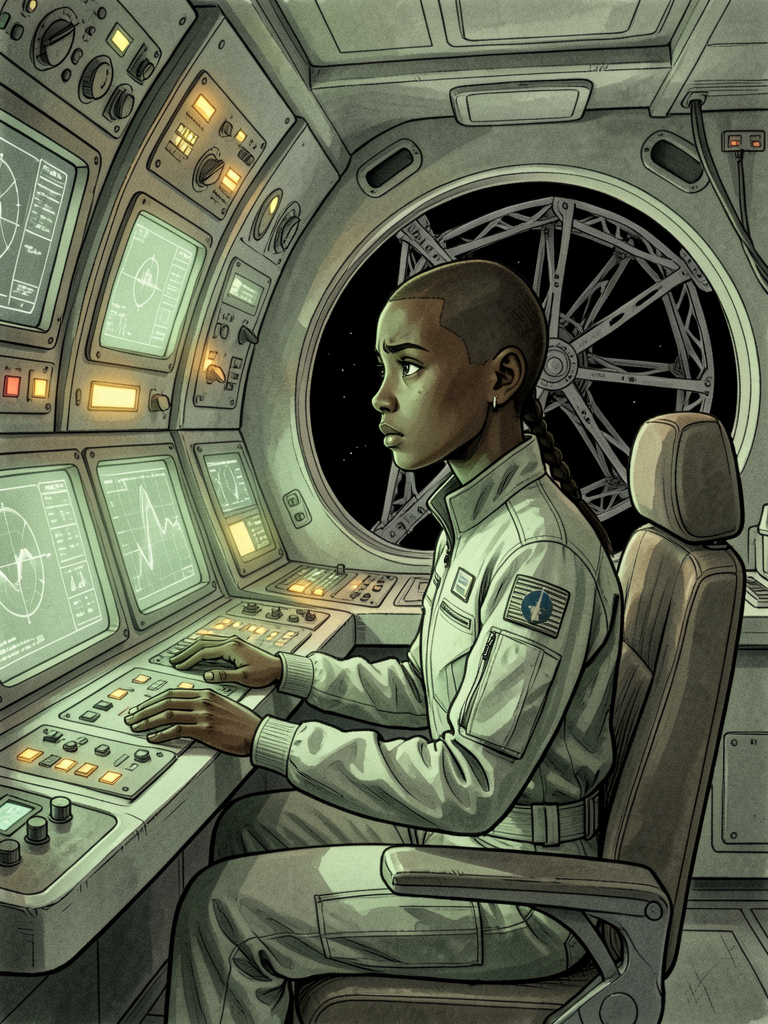
Sunna sat up.
MEMORY STACK: 1 ANOMALY.
That was not a line the report had ever contained. She had read eight hundred and twelve of these reports. They had three lines. They never had four.
She opened it. The next line read: VOLATILE BUFFER: 1 PACKET RESIDENT, UNINDEXED. INDEX ENTRY CORRUPT. RESIDENT TIME: 414D 03H 51M.
Sunna read it three times. Then she read it a fourth time, more slowly, and pulled the raw segment, and looked at the packet header, and her hands went cold in the warm little room.
Four hundred and fourteen days.
The relay's uplink amplifier was degraded. It had failed—not softly, but properly, with a lockup—sometime in the last year, and when it had, the relay's buffer had taken a packet from the local contract channel, and the packet had gone into the volatile stack, and the index had corrupted, and the relay had been sitting there ever since with a letter in its mouth and no way to swallow.
Nobody had come to fix it. Nobody had come at all.
Sunna sat back. The hum went on. She looked at the packet header for a long time. ORIGIN: HOLLIS DRAY CHARTER, CONTRACT OFFICE, CRADLE. DESTINATION: TENDER TALLOW, HULL 217. CLASS: NOTICE.
She tried to read the body and got nothing—the index was corrupt, and the buffer would not serve an unindexed packet to a reader. It wanted permission it could not give itself.
She could have called Ora at once. She should have called Ora at once; that was the standing order, and she knew it, and instead she sat there for forty minutes with her hands wrapped around a mug of cold coffee, looking at a letter addressed to her ship that had been waiting, unread, since the day before the relief was due.
At 05:40 she opened the comm and called the captain's cabin.
“Ora,” she said. “You need to come down here. I've found something, and I don't know what it says, and I think it's for us.”
Chapter 5: What the Packet Said
They worked on it for nine hours.
Everyone came. Ilya brought the good coffee, the brick they had been saving; Teo brought tools and a hardline; Hana brought the relay's maintenance manuals, all six volumes, printed, because the manuals were older than the practice of storing manuals digitally. Ora stood behind Sunna's chair with her arms folded and said nothing for a long time, which was the most useful thing she could contribute.
The problem was the index. The relay's buffer would not release a packet whose index entry was corrupt; that was a safety design from a more careful century, meant to prevent exactly this—garbled mail, half-read contracts, notices with their teeth pulled. Sunna went in through the back: the buffer's volatile stack had a maintenance port, and the maintenance port had a checksum routine, and the checksum routine was, as Teo put it, sixty years old and dumber than a bucket.
At hour seven she had a clean copy. At hour eight she had a date. RECEIVED: DAY 398.
At hour nine she had the text.
“Read it,” said Ora.
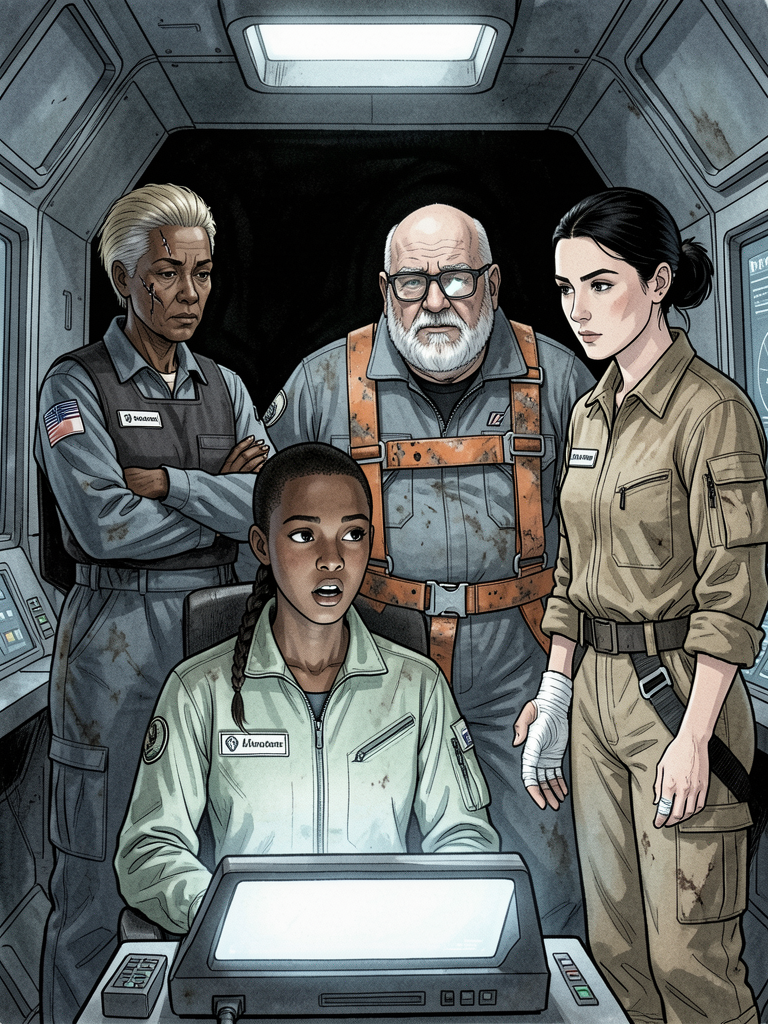
Sunna read it.
“Hollis Dray Charter. Contract Office, Cradle. Notice forty-four C, addendum to the Dray Relay Chain Maintenance Program. To all stations and vessels in the Dray chain.” Her voice was steady to begin with. It did not stay steady. “Effective day four hundred of the current fiscal year, the Dray Relay Chain, including relay stations one through eleven, is hereby decommissioned and removed from the active navigation schedule. Traffic on the Dray lane was rerouted to the Vestal Chain on day three hundred and forty-one. No further maintenance, resupply, or relief operations will be conducted on the Dray chain.”
She stopped.
“Go on,” said Ora.
“Vessels assigned to the Dray chain maintenance program are released from contract as of the effective date. Tenders unable to make independent transit will be recovered at the discretion of the office, subject to the availability of funds.” Sunna swallowed. “Tender Tallow, hull two one seven, is recorded as expended. Fourth quarter write-off, category C. No recovery authorized.”
The room was silent. Outside, in the dark, the relay turned; Hesper Nine, sixty-one years old, turning once every eleven minutes; the fence.
“There's more,” Sunna said. “There's a second file. It's not part of the notice. It's—it's attached to it. It's addressed to me.”
“Read it,” said Ora.
“It's not—it's not from the office. It's a routing receipt.” Sunna's voice did something. “It's the outbound queue manifest for the Tallow for the period of the tour. All traffic originating aboard, held pending transmission. Eight hundred and twelve items. It says: untransmitted. It says: amplifier lockup, day three hundred and ninety-one. Queue held pending maintenance. Maintenance not scheduled.”
Ilya said, very quietly, “Since day three hundred and ninety-one.”
“Since day three hundred and ninety-one,” Sunna said.
Nobody moved.
“Everything,” said Hana, eventually.
“Everything,” said Sunna. She had gone very pale, which on her was easy to see. “Since day three hundred and ninety-one. Every letter. Every—every picture. Every maintenance request. Every log submission. Every query the captain filed. All of it. It's sitting in the relay's stack. Eight hundred and twelve things that we wrote and that never went anywhere at all.” She laughed once, a bad laugh. “Four hundred and twelve of them are yours, Ora.”
“And the notice came in,” said Teo. “The notice came in on day three hundred and ninety-eight.”
“Yes.”
“And it went into the buffer, and the buffer wouldn't read it, and it has been sitting there for four hundred and fourteen days, one metre from my head, in a machine I have personally serviced—what—nineteen times.”
“Yes.”
Teo got up and walked out of the comm bay. They heard him going down the spine, hand over hand, faster than a man his age should have moved, and then they heard a hatch, and then nothing.
Ora stood with her arms folded and looked at the screen: Tender Tallow, hull 217, recorded expended. Category C. No recovery authorized.
“How long,” said Hana, hoarse, “have we been dead?”
“Four hundred and fourteen days,” said Sunna.
“I mean—” Hana stopped. Started again. “I mean, on the books. When did we stop existing, on the books?”
Ora answered that one. She had spent thirty years in a company that spoke in ledgers, and she knew exactly what the words meant.
“Day three hundred and ninety-eight,” she said. “Two days before the relief was due. Somebody at Cradle sat down with the schedule and looked at the cost of sending a ship out here to bring us home and looked at the cost of writing us off, and the second number was smaller, and that was the whole decision. There was no meeting. Nobody argued. It took one person four minutes.”
“We're not dead,” said Ilya. “We're depreciated.”
“That's worse,” said Hana.
“Yes,” said Ora. “It is.”
She looked at Sunna, who was sitting very still with her hands flat on the panel, and at the eight hundred and twelve unread items in her queue—small things, letters, the shape of two years of trying to reach out through a wall—and she thought about a hold order given at Anselm twenty-six years ago, and nine people, and a scar along her jaw that she had told everyone was a machine shop accident.
“All right,” she said. “Wake me in six hours. Nobody touches the relay. Nobody touches the reactor. We're going to sit down, all five of us, and we are going to decide what we are, now that we know.”
Chapter 6: Two Kinds of Staying
They met in the galley, because it was the only place on the ship where five people could be in one place and look at one another, and because the tally was on the wall.
Teo had come back. His eyes were red and his beard was wet, and he had changed into a clean coverall, which on Teo meant something—it meant he had decided to be a person and not a mechanic. He sat with his hands on the table and did not say anything for the first ten minutes.
Ora stood. She had learned, on the Wren, that people will listen to a captain who stands.
“We have four things,” she said. “Stores, eighty-eight days. Reactor, capped at sixty-two percent. One burn to the lane at ninety percent, which we do not have. And a notice from the charter office dated day three hundred and ninety-eight saying that we were written off as expended and that no recovery is authorized, which was four hundred and fourteen days ago.”
She let that sit.
“So here is the situation, honestly. Our post has been decommissioned. Our employer has declared us lost. Our relief was never launched. And if we stay here, in eighty-eight days we begin to starve, and the relay keeps turning, and in sixty years somebody finds five skeletons and a wall with a lot of lines on it. Those are the facts. I want a decision today. Not because I am in a hurry, but because the burn window is a real thing and it has a date, and every day we sit here, that date gets closer and the fuel gets further away.”
“And the second thing,” said Hana.
“Say it,” said Ora.
“The second thing is that the decision isn't stay or go.” Hana leaned forward. She had the burn plan on a slate in front of her, and she turned it around so they could all see it, though none of them could read it at table distance. “We can't go. Not the way we are. Teo?”
Teo looked at the table.
“Say it, Teo.”
“At ninety percent the injector flashes,” Teo said, to the table. “The sleeve is gone. I've written the report. There is no repair on this ship.”
“So we can't burn,” said Hana. “Unless.” She looked at him. “Say the rest.”
“There isn't a rest,” said Teo, and then closed his eyes. “There is. The Nine's Perpetua cell. It's bigger than our whole feed line and it's got two-thirds of its life in it. Graft it to us and we can hold ninety-five until the fuel runs out, and the fuel will outlast us, and we will make the lane.”
“And the relay dies,” said Ilya.
“The relay dies,” said Teo.
The drum turned. Somewhere in the hull a pump cycled, twice.
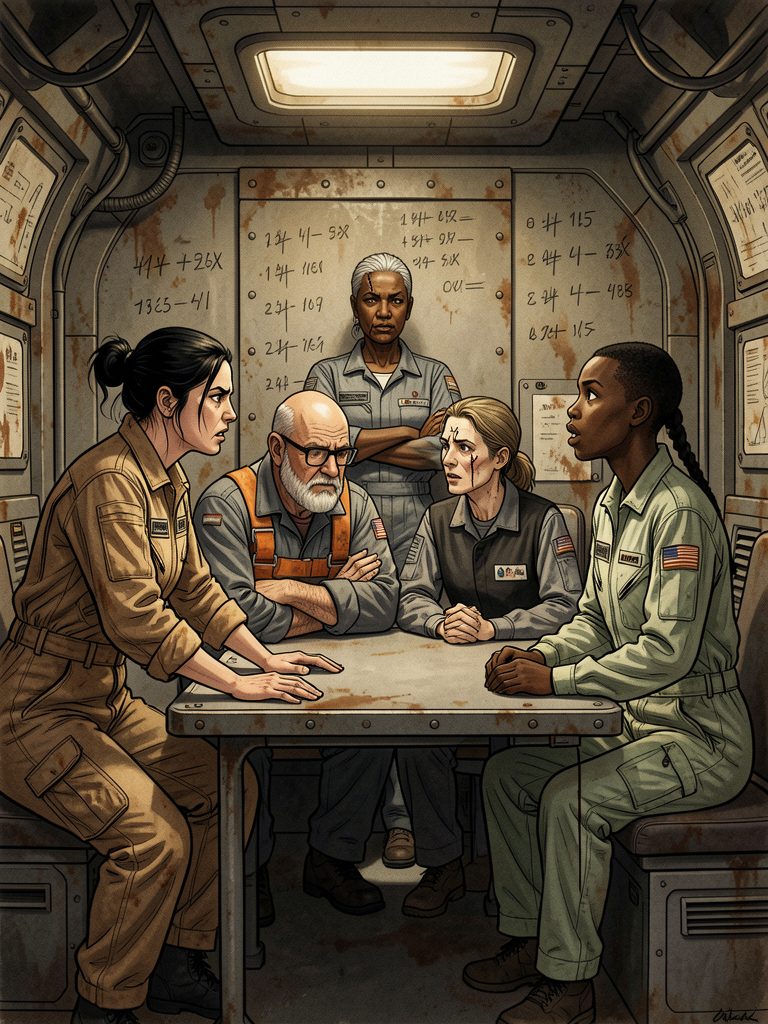
“So,” said Ora. “That is the decision. It isn't do we leave. It's do we kill the Nine.”
“We should kill it,” said Hana. “It's a machine.”
“It's a machine that has been running for sixty-one years,” said Ilya. “And it is the only thing in this hollow that anybody built for a reason other than us.”
“That's poetry,” said Hana. “I'm talking about a child. My daughter is nine years old. Rey. She was seven when I left. I have a photograph of her with a gap in her teeth and I have not seen her in eight hundred and twelve days and I have been told by the charter office that I am expended, that I am a line in a ledger. I am not going to die out here to keep a lamp lit for a lane that nobody uses.”
“The lane was moved,” said Teo. “The fence was moved. There's a new chain two hundred million kilometres spinward, and it does the same job. The Nine is redundant. I know that. I have known it for a year. I have been repairing a redundant machine because—” He stopped.
“Because why?” said Ilya, gently.
“Because the alternative is that I spent two years doing nothing,” said Teo. “And I would rather have spent it doing something.”
Nobody said anything for a while.
“There's another way,” said Sunna.
They all looked at her. She had her hands wrapped around her mug, and she had been quiet through the whole of it, and now she spoke as if she had been waiting for a gap and had gotten tired of waiting, which was in fact the case.
“We fix the amplifier first,” she said. “It's broken. It's been broken for four hundred and twenty-one days and we all know it, and nobody has fixed it. Teo, you said it needed a new driver stage and we don't have the parts. But the Nail's got a driver stage in its comm package that will fit. It's lower power. It only pushes a fraction of what the Nine can push, but it's enough, and it means the Nine isn't dead. It means the Nine can transmit.”
“Transmit what?” said Hana.
“The packet,” said Sunna. “The notice. Everything in the queue. All eight hundred and twelve things. And—” She stopped, and started again. “And a message. From us. Saying what happened, and where we're going, and who we are.”
“The lane is dark,” said Hana. “Nobody's out there to hear it.”
“The lane is dark here,” said Sunna. “But the Nine's dish is a lens. It points down the lane. Since we got here I have been listening to the lane, and I know the lane is empty for a hundred and forty million kilometres. But the chain—” She was leaning forward now, and her hands were off the mug. “The chain is a chain. There are eleven relays. Ten of them are on the Vestal schedule now, but the Nine is a lens, and a lens is a lens whatever the schedule says, and the Nine's dish can put a signal into the old corridor, and the old corridor still goes somewhere. It goes to the Shoal. And the Shoal is a junction—it's a junction between the old lane and the Vestal lane, and it's a junction with a marker buoy on it, and that marker buoy has been out there for forty years with a receiver on it, and if we put a signal in the corridor, the buoy will answer it, because that is what a buoy does.”
Silence.
“And then?” said Ora.
“And then there's a copy of us at the junction,” said Sunna. “Sitting on a buoy. Where somebody might trip over it.”
Ilya laughed: one short note, not unkind. “That's the long way round to say, shout into the dark and hope.”
“Yes,” said Sunna. “It is. But the relay stays alive when we take its cell, because we're not going to leave it dark. Teo gets to keep his fence. Hana gets her burn. And the eight hundred and twelve things in that queue—my letters, Ora's queries, the pictures of my niece—they get out.”
Teo looked at her for a long, long moment.
“You want to strip the Nine down to a lamp,” he said.
“I want to leave it standing with a light in the window,” said Sunna.
Ora looked at the five of them: at Teo, who was sixty-three and had a bean plant; at Hana, whose daughter had a gap in her teeth; at Ilya, who had been lying to a form for eleven months; at Sunna, who was twenty-six and had been writing to her sister every day since the tour began.
“Tomorrow,” said Ora. “I'll give you my decision tomorrow.”
Chapter 7: The Turn
That night Ilya knocked on the captain's door with two cups and a bottle of the medical alcohol, which was technically not drinkable, which had never stopped anyone.
“No,” said Ora.
“Yes,” said Ilya, and came in.
Ora's cabin was a bunk, a locker, a fold-down desk, and a screen she had been avoiding. She was sitting on the edge of the bunk with her boots off. Ilya sat down on the floor with their back against the locker, which was a thing they had done before, over the years, on bad nights.
“Say it,” said Ora.
“You've decided already,” said Ilya. “You decided the moment Sunna said we fix the amplifier. You've spent six hours pretending you haven't because you think it's your job to make it difficult.”
“That is my job.”
“It's a job you do very well.” Ilya poured two fingers of alcohol into each cup. It tasted like a hospital. “Are you going to tell me about the Wren?”
Ora took the cup. She looked at it for a while.
“I was thirty-two,” she said. “Tug pilot, Anselm yards. There was a construction crew working the outside of a hull out past the breakwater—nine of them, in a can, riding a barge. The barge lost station.” She drank. “The way it works out there is you don't bring a barge back by main engine; you bring it back with tugs, three of them, and you take it slow, because the can is not rated for acceleration and the crew inside are not rated for acceleration, they're rated for construction.”
“And the tugs?”
“I was on one of them. There was a hold order.” Ora turned the cup in her hands. “The barge was drifting into the breakwater's exclusion volume, and if she went in, she was going to take the breakwater with her, and the breakwater is a six-hundred-metre structure with a lot of people on it. So the yard control gave a hold order. All tugs hold position, do not engage, do not place your tug between the barge and the structure. They were going to let the barge go in and lose nine people instead of nine hundred.”
“And you held.”
“I held,” said Ora. “For eleven minutes, while the barge went into the exclusion volume, and then the breakwater took her, and it was not nine hundred. It was nine, and twelve more from the structure, and the nine in the can.” She set the cup down. “There was a woman named Adeyemi on the second tug. Her name was on the incident report as hold-order compliant. Mine was on it as hold-order compliant. We both got commendations. I have the commendation in a box somewhere, I think. I stopped opening the box in about year three.”
Ilya was quiet.
“So,” Ora said. “You want to know why I have kept this crew in this hollow for four hundred and twelve days past the day we were supposed to leave. That's why. Because the last time I did the arithmetic and decided that the order was wrong, it was not the order that was wrong. It was me. And I have spent twenty-six years since then making sure that whatever else I do, I do not make a decision about other people's lives based on my own certainty.”
“That's not what happened,” said Ilya.
“It is exactly what happened.”
“No.” Ilya set down the cup. “What happened is that you were given a hold order that was legal and correct and that killed nine people, and you have been carrying it as though it was a failure of obedience, because the alternative—” Ilya stopped, and started again more gently. “The alternative is that it was a failure of the men who wrote it, and that you were the instrument, and that is a harder thing to live with, because there's nothing you can do about it. But the other thing, Ora—the thing you keep leaving out—is that there were eleven minutes. And in those eleven minutes, nobody on that second tug or the third one broke the order either. Not one of you. And when you tell that story you always sound surprised.”
Ora looked at her hands.
“There was one more thing,” she said.
“Yes.”
“At minute eight, I asked control for permission to place my tug in the path. To take the hit on the tug—we had crew in suits, we could have abandoned to the second tug—and put something between the barge and the structure. And control said no. And I have thought about that no for twenty-six years, and the thing I have never been able to decide is whether the no was right.” She finally looked up. “And that is what I have been doing out here, Ilya. I have been sitting in a hollow with a hold order in my hand, waiting four hundred and twelve days to find out whether the no was right. And now I've found out.”
Ilya waited.
“The no was wrong,” said Ora. “Nobody even said no. Nobody said anything. Somebody did a two-minute cost calculation on day three hundred and ninety-eight and wrote expended.”
She picked the cup back up and drank the rest of the medical alcohol, which did not help, which was not the point.
“Tomorrow I'm going to tell them,” she said. “We fix the amplifier. We send everything we've got. We pull the cell, we leave the lamp lit, and we go.”
“And Teo?”
“Teo will do the cell,” said Ora. “He's already decided. He decided the moment Sunna said a light in the window, and he's been sitting there ever since trying to work out whether it's a betrayal or a promotion. He'll come around by breakfast, because he wants to be the man who fixed it and the man who let it go, and there is no way to be both except to do the work.”
Ilya smiled, a small tired one.
“That's very good captaincy,” they said.
“I've had four hundred and twelve days to think about it,” said Ora.
Morning, the galley
Morning came, and Ora went to the galley and took the grease pencil off its hook.
They were all there. She had asked them to be there. Nobody spoke.
She drew the line for day eight hundred and thirteen.
Then, under it, under the slanting scrawl and the careful capitals and Teo's square hand—Then why are we still here?—she wrote, in letters big enough to read from the door:
DAY 814: UNDER WAY.
“That's tomorrow,” said Sunna.
“That's the plan,” said Ora. She hung the pencil back on its hook. “Here's the work. Teo and Sunna, the amplifier. Hana, the burn—full plan, tank configuration, mass dump, the whole thing. Ilya, every consumable we can spare, sorted and packed for two hundred and forty days of cold coasting, and a medical plan for the part where we are all very unhappy. And me, I'm going to write the message, and then I'm going to say it out loud, and then we are going to leave this place with the door open and the light on.”
She looked at Teo.
“Teo. Can you do it?”
Teo Marchetti looked at the wall, at the tally, at the lines he had spent eight hundred and thirteen days counting.
“I can do it,” he said. “Somebody has to be the last one to touch it.”
Chapter 8: The Work
The amplifier took nine days.
It should have taken four. They did it in nine because Teo insisted on doing it properly, and because doing it properly meant eleven EVAs in a rotation that left them in suits for six hours at a time, and because on the fourth day the work made a hole in Teo's glove.
The uplink amplifier was a box the size of a coffin mounted at the base of the Nine's dish, and it had been dead for four hundred and twenty-one days. Its driver stage—the part that took the relay's small, clean signal and pushed it up the throat of the dish—had cooked itself when the dish's thermal control failed, and the replacement from the Nail was half the size and a tenth the power, and fitting it was like transplanting a mouse's heart into a horse.
They did it in pieces. Hana flew the Nail. Ora ran the outside, on second watch. Teo and Sunna worked in rotation, because the fine work needed two hands and the fine work was in the deepest part of the box where a person could only get one arm in, and because Sunna had the steadiest hands on the ship and Teo had the eyes.
Inside the Tallow, Ilya ran the airlock and the clock and the medical kit and did not sleep much.
The hole in the glove happened on day four, at hour five of a six-hour EVA, and it happened the way those things happen: not dramatically.
Teo was threading a coax through a gland in the amplifier's skin, and his right hand was deep inside the housing, and he felt a small cold sting on the back of his hand, and he thought—he told Ora afterwards, in the medical bay, with his hand in a bag—he thought it was a nick from a burr, and he kept working for eleven seconds, and then his brain caught up and he said, in a voice so calm that Ora did not immediately understand him: “I'm compromised.”
Ora was two metres away at the panel. She had him in the airlock in ninety seconds. She had his hand under the hot-water feed in three minutes. His glove had a split of less than a centimetre along the seam of the third finger, and the vacuum of Hesper Nine had gone in like a needle and taken the skin on the back of his hand in a patch the size of a coin: white, hard, dead, and cold as stone.
Ilya did the dressing on the Tallow. Teo sat on the medical bench and watched them work and said, twice, “I want to go back out,” and Ilya said, twice, no, and did not raise their voice, and Teo, who was sixty-three and had been in suits for forty years and had never once been compromised, cried a little, briefly, and then stopped, and then asked for the coffee.
“Six days,” said Ilya. “Then the hand's fit for a light glove. Not this.”
“Sunna can finish the gland,” said Teo. “She's better at it than I am. She's been better at it since the fifth EVA. I kept her off it because I wanted to do it myself.” He looked at his hand. “That was vanity. It cost us three days.”
“It cost us a hand,” said Ilya.
“It cost us a patch of hand,” said Teo. “I have twenty fingers' worth of hands, roughly speaking. What it cost us is three days, and three days is what we had.” He looked at Ora. “Tell her to finish it.”
“She's already out there,” said Ora.
Sunna finished the amplifier on the ninth EVA, alone, with Teo talking her through it over the comm from the lock, and when she sealed the housing and stepped back into the Nail's cage and Hana brought them home, the first thing they did was switch it on.
The Nine answered.
There was a hum—a low, clean hum, coming up through the relay's bus, a sound none of them had heard in four hundred and twenty-one days—and then a string of telemetry, and then, on Sunna's panel, the words: UPLINK: NOMINAL.
Sunna Oyelaran sat in the comm bay and cried for about ninety seconds, alone, with the hum in the walls, and then blew her nose and logged the repair.
Meanwhile, in the cockpit
Hana had been building the burn.
Her plan had gotten very detailed. They would strip the ship before the burn: dump the drum's counterweight, cut away the grapple arms—each of them thirty tonnes, and Teo made them do it himself with a grinder, and he did not speak for the whole of the second one—vent the water reserve down to the medical minimum, and strip every locker on board of anything that was not a person, a suit, a ration, or a tool. All of it would be jettisoned and left behind in the hollow, spinning slowly: a little cloud of the Tallow's history going nowhere forever.
The burn itself: nineteen hours at ninety to ninety-five percent, if the cell graft worked. Then a shutdown, a cold coast for two hundred and forty days, and an arrival at the Shoal with, Hana estimated, a reserve of four percent. Just enough to catch the marker buoy and hold station.
“Four percent,” said Ora, when she saw the number.
“That's with the cell,” said Hana. “Without the cell it's negative eleven percent, which means we fire the burn, coast, run out, and die in the dark about nine days before we arrive. I put that in the plan too. I wanted you to see it.”
“Thank you,” said Ora. “I didn't need it.”
“You needed it,” said Hana. “Now you can stop pretending this is a choice.”
The message
And on the sixth night, Ora sat down to write the message.
Sunna had given her the format: a beacon transmission, on the old corridor band, on repeat, with the standard header and the standard distress class, and then whatever she wanted. Two minutes of audio. That was all.
Ora wrote it four times.
The first draft was a report, and it was correct, and it was useless. The second draft was angry, and it was honest, and she would not have said it aloud: There was no meeting. Whoever wrote us off in two minutes—that person's name should be on this transmission, so everyone can see it, because it took me four minutes to think about it and I have never met them and I hate them.
The third draft was a list of names.
The fourth draft was what she sent.
This is the repair tender Tallow, Hollis Dray Charter hull two one seven, and this is Commander Ora Devane. We are the crew of a ship that was written off four hundred and twenty-two days ago and that is only now finding out about it, because the notice was sitting in a buffer one metre from our heads the whole time. We are not angry about that. That is not true; we are extremely angry about that. But we are not transmitting this in order to be angry.
Attached to this transmission is every piece of mail, every query, every log and every picture that the crew of the Tallow wrote in the last four hundred and thirty days, which never went anywhere. It is eight hundred and twelve items. Some of them are contracts. Some of them are letters to children. There is a picture of a baby named Ife who is fourteen months old and whose aunt has never seen her, and there are four hundred and thirteen queries from a captain who was doing her job, and there is a maintenance request about an amplifier that nobody answered, which is the reason all of the rest of it is late.
There is also this, and we would like it entered somewhere: on day three hundred and ninety-eight, Hollis Dray Charter declared the Tallow expended and authorized no recovery. The people listed below were aboard her, alive, at the time. Ilya Voss, medic. Hana Reyes, pilot and quartermaster. Teodor Marchetti, engineer. Sunna Oyelaran, signals. Ora Devane, commander.
We are not expended. We are leaving Hesper Nine on the four hundred and twenty-second day past our scheduled relief, under our own power, with a burn we had to cannibalize a sixty-one-year-old navigation relay to make. We expect to reach Hesper Shoal in two hundred and forty days. We are going to be there. If anyone is listening, that is where we will be.
The Hesper Nine relay will remain in operation. We are taking its main power cell and leaving it a lamp. It will keep transmitting this message on the old corridor until the cell is done. That is a promise from a man named Teodor Marchetti, who has kept that relay alive by hand for eight hundred and twenty days, and who is going to be the last person to touch it. Tallow, out.
Sunna recorded the file at 04:00, which was the hour the relay liked to do its housekeeping.
Chapter 9: The Broadcast
They transmitted for forty hours.
The old corridor band was not a busy frequency; it had not been a busy frequency since Ora was a child. But the Nine's dish was a lens, and the lens did not care about schedules. Sunna pointed it down the lane and pushed, and the amplifier hummed at the base of the dish like a bee in a jar, and the signal went out—not fast, not loud, but out, and the corridor carried it, and the corridor led to the Shoal, and the Shoal had a buoy, and the buoy had a receiver, and the receiver had a log, and in forty years the log had four entries and none of them had ever been read by a person.
The packet traffic went first: eight hundred and twelve items, in a burst, at a compression the receiver at the Shoal would unpack and store. Then the message, on repeat, forty hours of it, Sunna's voice and Ora's voice alternating. This is the repair tender Tallow.
Then Sunna added something of her own, which she did not tell anyone about until afterwards, at the end of the forty hours, when it had already left: a one-minute recording at the tail of the loop, of her saying, simply, “Aziza, it's Sunna. Ife is beautiful. I'm coming.”
Ora found out about it because Hana asked, at breakfast, why Sunna was grinning.
“I sent a letter,” said Sunna.
“I thought we sent all of them.”
“I sent a new one,” said Sunna, and would not say anything more, and Hana looked at Ora and Ora shrugged, and Ilya said, Hm, and Teo laughed, which he had not done in nine days.
The cell
Then they took the Nine apart.
It was the strangest work any of them had ever done, and it took four days, and it was done with the care of people taking down a church.
The Perpetua cell lived in the Nine's heart, at the hub of the wheel, in a housing the size of a small room, with its own thermal system and its own shielding and its own small, patient hum. It had been made on Cradle sixty-one years ago. It was three hundred and twenty kilograms of isotope in a lattice, and it had been dropping power to the relay's bus at a level nowhere near its capacity since before any of them were born, because the relay did not need much, and it would go on dropping power at that level for another hundred and forty years if nobody touched it.
Teo went in first, alone, and stayed four hours, and came back with a hand-drawn schematic and a list.
“It's beautiful,” he said, at dinner, and meant it, and everyone let him have it.
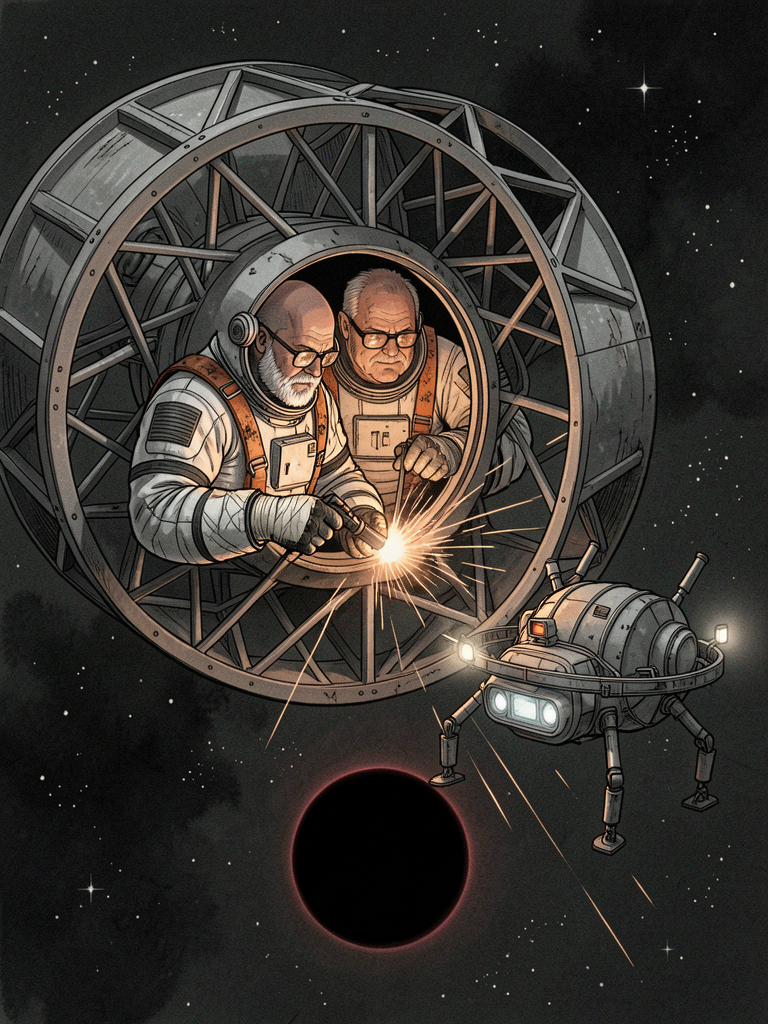
Then the four of them took it out.
The housing had to be cut; the cell could not be removed through the door. They cut it in increments over two days, with a grinder, in suits, in the dark, in the cold, and they moved it in three pieces to the Nail's cargo cradle, and then, over one very long day, they moved it from the Nail to the Tallow and down the spine and into the reactor bay, and Ilya stood by with the medical kit, and Hana flew everything at half a metre a second, and Ora talked, steadily, the whole time, the way you talk to someone carrying something heavy.
The graft took two more days. Teo did the feed line himself with one good hand and Sunna's help, and when it was done the Tallow's reactor, which had been a sixty-two-percent creature for two years, came up like a held breath.
“Ninety-six,” said Teo, from the bay, over the comm. “And it's stable. And it could hold this until the stars go out.” He paused. “Which, you know. One of them did.”
The lamp
And after that, the lamp.
This was Teo's, and he did it alone, and he did it on the eighth day, at the end of the last EVA any of them would make in this hollow.
The Nine had its own small emergency cell—a backup that had never been used, rated at eleven percent of the main cell's output, good for about forty years of running a beacon at low power. Teo cut the bus over, fed the emergency cell into the amplifier's drive, and brought the dish's gain down to almost nothing: a whisper, aimed down a corridor at a junction a hundred and forty million kilometres away.
Then he loaded the loop. The message went into the relay's buffer, on the little cell, where it would sit, and repeat, and repeat, and repeat, each time it ran eating a little more of the cell's life, until there was nothing left but a wheel of wire and a dead star and a hollow where nothing had ever happened.
“It'll run about thirty-one years,” he told them, at dinner. “The message is two minutes. That's—I did the math. Somewhere around eight million repeats. So if somebody comes through here in thirty-one years, they'll hear us say hello.”
“And after thirty-one years?” asked Hana.
“After that it's a wire wheel,” said Teo. “But thirty-one years is not nothing. Thirty-one years is the whole working life of a person. Somebody will trip over it.”
He had brought his bean plant down from the green room in its tray and set it on the galley table for the dinner, which was their last dinner at Hesper. The bean had two yellow leaves and one small green shoot at the node. It was, everyone agreed, the ugliest plant any of them had ever seen, and they all had a sip of the medical alcohol to it, and Teo cried, and nobody mentioned it.
The last thing Ora did before the burn was to go out to the blister and look at the star.
She could see the Nine from there, a wheel of black wire against the stars, and if she looked carefully at a spot on the truss she could see a small green light: the emergency cell's status light, which would blink once every eleven minutes with the station's slow turn, for thirty-one years, whether anyone was watching or not.
A light in the window.
“All right,” she said, quietly, to nobody, which was how she had said good morning to the star in her first week, eight hundred and twenty days ago. “All right. We're going.”
Chapter 10: The Long Burn
The burn began at 04:00 ship's time on day eight hundred and twenty-four, which was the hour the relay had liked to do its housekeeping, and which Sunna had chosen for exactly that reason.
Everyone was strapped in. Hana had the cockpit. Ora had the left seat and said nothing. Teo and Ilya were in the drum, in the acceleration couches, with the medical kit strapped down between them. Sunna had the comm bay, though there was nothing on it, because she had asked to be at her station when the ship moved for the first time in two years and three months.
“Reactor at ninety-five,” said Teo, over the comm. “Feed is nominal.”
“Tank pressures nominal,” said Hana. “Course is laid in for the Shoal. Mass is where I want it. I'm going to light it in thirty seconds and I'm going to keep it on for nineteen hours.”
“Do it,” said Ora.
Hana counted down, out loud, in a level voice, from thirty to zero, and Ora watched the Nine through the cockpit window the whole time—the relay, the wheel, the tiny green blink—and at zero the Tallow began, very gently, for the first time in eight hundred and twenty-four days, to move.
There was no roar. There was a pressure in the seat and a low groan in the structure and a hum that came up through the frame into their bones. The Nine slid away in the window, very slowly at first, and then faster, and then it was behind them, and then it was a scatter of grey lines against the black, and then it was nothing, and then there was a place in the stars where the stars did not show, which was the relay, and then there was a place where they did, which was where the relay had been.
Hesper stayed in the window for a long time. It did not move, of course; nothing so large moved. But it shrank, over nineteen hours, from a sphere of black with a red rim into a coin, and then into a dot, and then into a point which was not distinguishable from the stars around it except that they knew, and then, at the end of the burn, at hour nineteen, when Hana shut down the reactor and the pressure went out of the seats and the Tallow went silent, Ora looked out the window at a nothing she could not find, and thought: that is where we were.
The coast was two hundred and forty days.
They had planned it, and Ilya had planned it hardest. The rations came down to a thousand kilocalories and stayed there. The drum was kept turning for two hours a day and then stopped, to save power, and they slept in the cold, all five of them, in the drum, because the ship was small enough that you could heat one room properly and no more than one.
It was not terrible. That surprised Ora, and she wrote about it in the log, which she still kept, day by day, in the same four minutes.
They read the manuals. They played cards—Ilya taught them a game called Anselm Whist, which they played to the point of blood feud. Hana told the story, at last, of the gap in Rey's teeth and the way she had measured her daughter's height against the galley doorframe every birthday, and then gone on a two-year tour and missed two of them. Teo's hand healed with a patch of skin that never regained feeling and which he showed to everyone at least four times. Sunna kept watch on an empty band for four hours a day and wrote in her journal, and did not stop writing in her journal, even though there was a booster now and the letters could actually go: two items a day, out along the corridor behind them, over the lens that was not a lens anymore, toward a junction where a buoy was keeping a list.
Ora wrote in the log. Day eight hundred and twenty-five. Day nine hundred. Day one thousand. Position: coasting, nominal. Crew: five, all living.
Day one thousand and sixty-three. At 04:00, which was the hour the relay had liked, Sunna Oyelaran came into the cockpit and woke her up by shaking her shoulder, and her face, in the dark, was doing something Ora had not seen it do in three years.
“Ora,” she said. “Ora. There's someone talking.”
The voice was thin and it was human and it was coming from a very long way away, and it said, in a flat, businesslike carrier:
—repeat, Tallow, hull two one seven, Hollis Dray Charter, this is the bulk carrier Fairweather out of Cradle, under contract to the Vestal chain, and we have your beacon. Say again, we have your beacon, and we have your packet traffic, and we have read every word of it, and copies are with the Vestal chain office and the maritime board and, at this point, with about nine hundred people, because a thing like this does not stay quiet.
Tallow, we have your position from your last transmission. We make you nine hundred and forty thousand kilometres from this marker, closing, and about forty days out at our best speed, and we have food, and we have water, and we have a doctor, and we have mail, and I want you to know that there are people on this ship who have been arguing for three days about which of you gets told first that the Vestal chain office has opened an inquiry into Hollis Dray Charter, and that the answer is all of you, at once, at the same time, because a man in the office at Cradle spent four minutes on you and we have all decided that we are going to spend rather longer than that.
Tallow, the Fairweather is on her way. Do you read?
Sunna was crying. She had the headset on and one hand over her mouth and she was crying in a way that made no sound at all.
Ora took the handset out of her hand.
“Fairweather,” she said, “this is Tallow, Commander Ora Devane. We read you.” She looked out the window at the stars, at nothing, at the point where Hesper had been, two hundred and forty days behind them, still turning, blinking green once every eleven minutes for nobody. “We read you. Good to hear a voice. What's your ETA?”
“Forty-one days,” said the Fairweather.
Ora looked around the cockpit at Sunna, at Hana, who had come up the spine in her sleeping clothes with her hair loose, at Teo and Ilya crowding in behind her, and at the drum beyond them, and the cold, and the count on the galley wall, which was not a count anymore, which was just a wall.
“Forty-one days,” said Ora. “We'll keep the lights on.”
She put the handset down and wrote the log entry, right there, with all of them watching:
Ship's log. Tallow, hull two one seven. Commander Ora Devane. Day one thousand and sixty-three. Position: under way, Hesper Shoal approach. Status: relief arrived. All five of us are alive. Nothing that was written down for four hundred and twenty-two days went unanswered, and the fence is still standing, and there is a light in the window, and we are going home.
A Note on the Hesper Relay
The physics in this book is quiet physics, which is to say that almost nothing in it explodes. A black dwarf — a star that has burned its fuel and cooled for so long that it radiates nothing you could see by — is a real consequence of stellar evolution, though the universe is not yet old enough to have produced many. The faint dull-red rim around Hesper is not romance; it is what is left of a temperature, a few kelvin above the background, bleeding away into a very long night.
Navigation relays in a chain are an old idea transplanted from an older ocean: a series of fixed marks, each one shouting its position down a corridor so that something blind can find its way. The gravitational lens that lets Hesper Nine push a whisper a hundred and forty million kilometres down a dark lane is also real, in the sense that gravity bends light and radio alike, and that a sufficiently patient antenna can use a sufficiently large mass as a megaphone.
What is invented here is the paperwork. The Perpetua cell is fictional; the contract office is not. The most frightening machine in this novel is a ledger, and the most frightening sentence in it is two words long: no recovery authorized. Nothing in the book required a villain, and none appears. It required only a sufficiently large organization making a sufficiently small decision on a sufficiently ordinary afternoon, which is how most of the damage in the world is done.
The Tallow's crew are not heroes, and they do not save anyone. They fix a broken amplifier, they tell the truth into an empty corridor, they dismantle the thing they spent two years protecting, and they leave a light on behind them for thirty-one years in the hope that a stranger will trip over it. That is the whole of their achievement. It has always seemed to me that this is the shape of most real courage: maintenance, performed without an audience, by people who have already been told that they are not worth coming back for.
They were worth coming back for.
The Tallow's Log, Abridged
- Day 1. Position held. Hesper Nine relay nominal. Relief scheduled: day 400.
- Day 400. Relief due. Not arrived. Query filed.
- Day 391. Amplifier lockup. No scheduled maintenance. Outbound queue held.
- Day 610. Hairline crack located in number two injector moderator sleeve. Reactor capped at 62 percent. Not reported to charter office.
- Day 812. Eventful. Strut 3 repaired by hand. Tally continues.
- Day 813. Packet recovered from relay buffer. Notice 44-C: Tallow recorded expended, category C, no recovery authorized.
- Day 814. Decision taken. Relay to be repaired, then reduced. Cell to be grafted. Course for Hesper Shoal.
- Day 820. Uplink nominal. Amplifier repaired after nine days and one compromised glove.
- Day 822. Packet traffic transmitted. 812 items released. Beacon loop loaded.
- Day 824. Cell grafted. Relay on emergency lamp, transmit life estimated 31 years. Burn initiated at 04:00.
- Day 1063. Contact. Bulk carrier Fairweather, out of Cradle, closing. Relief arrived. All five of us are alive.